
Most of us spend around 90% of our time indoors — and the air inside our homes can be two to five times more polluted than outdoor air, according to the EPA.
Dust, pet dander, mold spores, volatile organic compounds (VOCs) from furniture and cleaning products, and even wildfire smoke can build up in enclosed spaces.
An air purifier helps — but choosing the right one means thinking beyond just filtration performance. The most eco-friendly models pair powerful air cleaning with low energy consumption, long-lasting filters, and minimal plastic waste.
Table of Contents
Why Indoor Air Quality Matters for Your Health and the Planet
Indoor air pollution is a real concern, and it’s not just about dust.
Everyday items like synthetic carpets, paint, furniture, and even scented candles release VOCs that accumulate indoors. Cooking fumes, pet allergens, and mold spores add to the mix — and without proper ventilation, they just keep circulating.
For people with asthma, allergies, or respiratory sensitivities, a good air purifier can make a meaningful difference in daily life.
But here’s the eco angle: a poorly designed air purifier can guzzle electricity 24/7 and generate regular filter waste. The greenest options are Energy Star certified, run efficiently on low-wattage settings, and use long-lasting filters that don’t need replacing every few months.
What Makes an Air Purifier Eco-Friendly?
Not all air purifiers are created equal when it comes to sustainability. Here’s what to look for:
Energy Star certification — This means the unit meets EPA efficiency standards and uses significantly less power than conventional models.
True HEPA filtration — Look for “True HEPA,” not “HEPA-type” or “HEPA-style,” which are unregulated marketing terms. True HEPA captures 99.97% of particles 0.3 microns and larger.
Long filter lifespan — Filters that last 12+ months reduce replacement frequency and filter waste. Some models include washable pre-filters that extend the life of the main HEPA filter significantly.
Auto/eco mode — Smart sensors that reduce fan speed when air quality is good save energy without sacrificing performance.
No ozone emissions — Avoid ionizer-based purifiers that produce ozone as a byproduct. Ozone is a respiratory irritant and an air pollutant in its own right.
Best Overall: Coway Mighty AP-1512HH
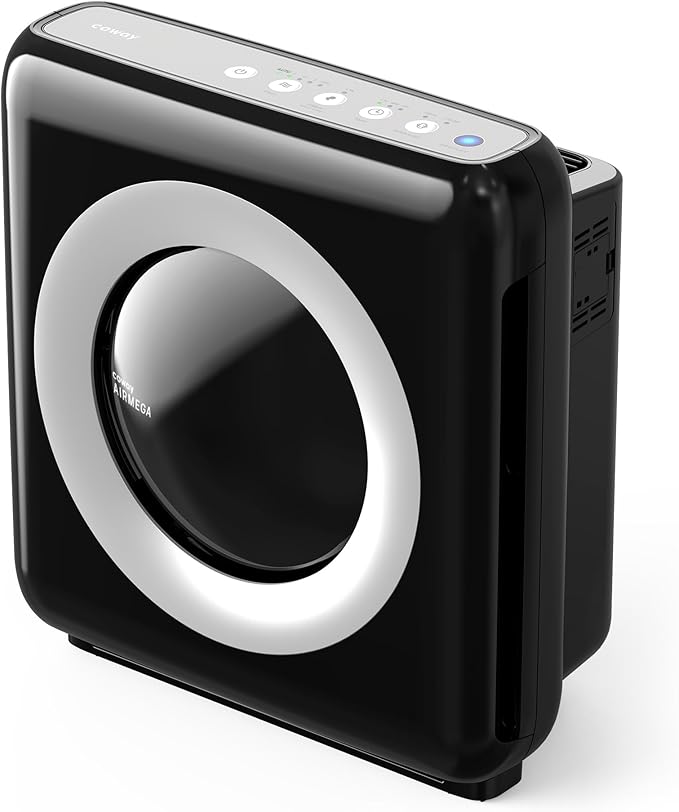
The Coway Mighty has been a perennial top pick in air purifier reviews for good reason — and it earns its eco-friendly credentials through genuine engineering rather than marketing fluff.
It uses a four-stage filtration system: a washable pre-filter, an activated carbon deodorizing filter, a True HEPA filter, and Vital Ion technology. The CADR (Clean Air Delivery Rate) is 233, making it effective for rooms up to around 360 square feet.
The standout eco feature is its Eco Mode, which automatically shuts off the fan when the air quality sensor detects clean air. That means it’s only working as hard as it needs to — cutting electricity use without any input from you.
It’s Energy Star certified, the pre-filter is washable (reducing waste), and the HEPA filter typically lasts 12 months. At around $100, it’s also one of the most accessible quality air purifiers on the market.
Best for Medium Rooms: Blueair Blue Pure 311i Max
Blueair’s HEPASilent technology is worth knowing about. It combines mechanical filtration (like traditional HEPA) with electrostatic filtration — using both methods together means the unit can achieve high particle capture rates while running the fan at lower, quieter speeds.
The result is an air purifier that pulls just 32 watts on high while cleaning rooms up to 387 square feet every 12.5 minutes. It’s earned the Energy Star Most Efficient designation, which is a step above standard Energy Star.
The Blue Pure line includes a washable fabric pre-filter that comes in several colors — it catches larger particles before they reach the HEPA layer, meaning the main filter lasts longer and needs replacing less often.
The 311i Max connects to the Blueair app, which lets you monitor air quality in real time, set schedules, and control fan speeds from your phone. Quieter and more efficient than most competitors at its price point, this is a great pick for bedrooms or home offices.
Best Smart Pick: Levoit Core 400S
Levoit has become one of the most popular air purifier brands in recent years, and the Core 400S shows why.
Its 360-degree air intake design draws air in from all sides, which improves efficiency compared to single-direction intake models. The CADR of 260 covers rooms up to 403 square feet, and the built-in laser particle sensor continuously monitors PM2.5 levels (fine particulate matter) in real time.
The smart features make a real difference for eco-conscious use. Auto mode automatically adjusts fan speed based on current air quality, so the unit isn’t running full blast when it doesn’t need to.
The Core 400S works with the VeSync app and is compatible with Alexa and Google Assistant — handy for setting schedules that match your routine. Sleep mode runs at just 24 dB, barely audible in a quiet room.
Replacement filters (which combine the pre-filter, HEPA, and carbon layers in one unit) last around 6-8 months depending on usage and air quality. Levoit’s filter recycling program accepts used filters by mail — a nice touch that reduces landfill contribution.
Tips to Maximize Your Air Purifier’s Eco-Impact
Keep doors and windows closed when the purifier is running so it’s cleaning a defined space rather than an open system.
Use auto mode whenever possible — it lets the unit’s sensor determine the appropriate power level, avoiding unnecessary energy use when air quality is already good.
Clean the pre-filter regularly — most washable pre-filters should be rinsed every 2-4 weeks. This dramatically extends the life of the main HEPA filter and reduces how often you need to buy replacements.
Size it right — an undersized unit will run on high constantly to keep up, using more power. An oversized unit in a small room is wasteful too. Match the CADR to your room size for optimal efficiency.
Pair with low-VOC products — switching to plant-based cleaners, natural candles, and low-VOC paints reduces the pollution load your purifier has to handle, letting it run at lower speeds more often.
The Bottom Line
Clean indoor air is one of those quality-of-life improvements that’s easy to overlook until you experience it firsthand — better sleep, fewer allergy symptoms, and a fresher-smelling home are the immediate payoffs.
Done right, an air purifier is a genuinely sustainable investment. Energy-efficient models like the Coway Mighty, Blueair Blue Pure 311i Max, and Levoit Core 400S clean the air without running your electricity bill up — or leaving a trail of filter waste behind them.
Focus on True HEPA filtration, Energy Star certification, a built-in auto or eco mode, and long-lasting filters. Those four criteria will steer you toward a purifier that’s as easy on the environment as it is on your lungs.